.png)
Got Likes?

Social media is the drug epidemic of our era — engineered to addict, algorithmically targeted, and already inside every classroom, every bedroom, and every pocket in America. We've been here before. We looked away then too.
In 1983, America named a crisis it had been slow to see. Crack cocaine was flooding communities. It moved fast, hit hardest in places already hollowed out by poverty and disinvestment, and destroyed the generation it found.
By the time the country responded — with legislation, with DARE in every school, with a nationally coordinated public health strategy — the damage was already deep.
We are living through that same inflection point right now. Different drug. Same playbook of delay. Same communities absorbing the worst of it first.
Social media is not a tool some children are misusing. It is a system engineered, at the neurological level, to produce compulsive behavior in the least defended brains available. Former tech executives have said this out loud. The Surgeon General has issued formal warnings. Dozens of peer-reviewed studies have documented the damage. And yet — as with crack in the early 1980s — the systems responsible for protecting young people are still treating this as a parenting problem rather than a public health emergency.

The Numbers That Should Stop You Cold
The inflection point is 2012 — the year smartphones became universal in American adolescent life. What followed was not gradual drift. It was a cliff.
150%
rise in teen depression since 2012
CDC
189%
rise in teen anxiety disorders since 2010
NIMH
57%
of teen girls feel persistently sad or hopeless
CDC 2023
3×
higher suicide attempt rate for heavy users
JAMA 2019
Hospital admissions for self-harm in girls surged 188 percent. Suicide became the second leading cause of teen death. These trend lines do not begin with the pandemic. They begin in 2012. The Surgeon General named youth mental health "the defining public health crisis of our time." This is not a moral panic. This is an epidemiological record.
Built to Addict
The average age of a child's first smartphone in the United States is now 10.3 years old. At 10, the prefrontal cortex — responsible for impulse control, risk assessment, and long-term reasoning — is nowhere near finished developing. These platforms were placed in the hands of children biologically least equipped to resist them.
Same dopamine pathway. Same developing brain. Different decade.
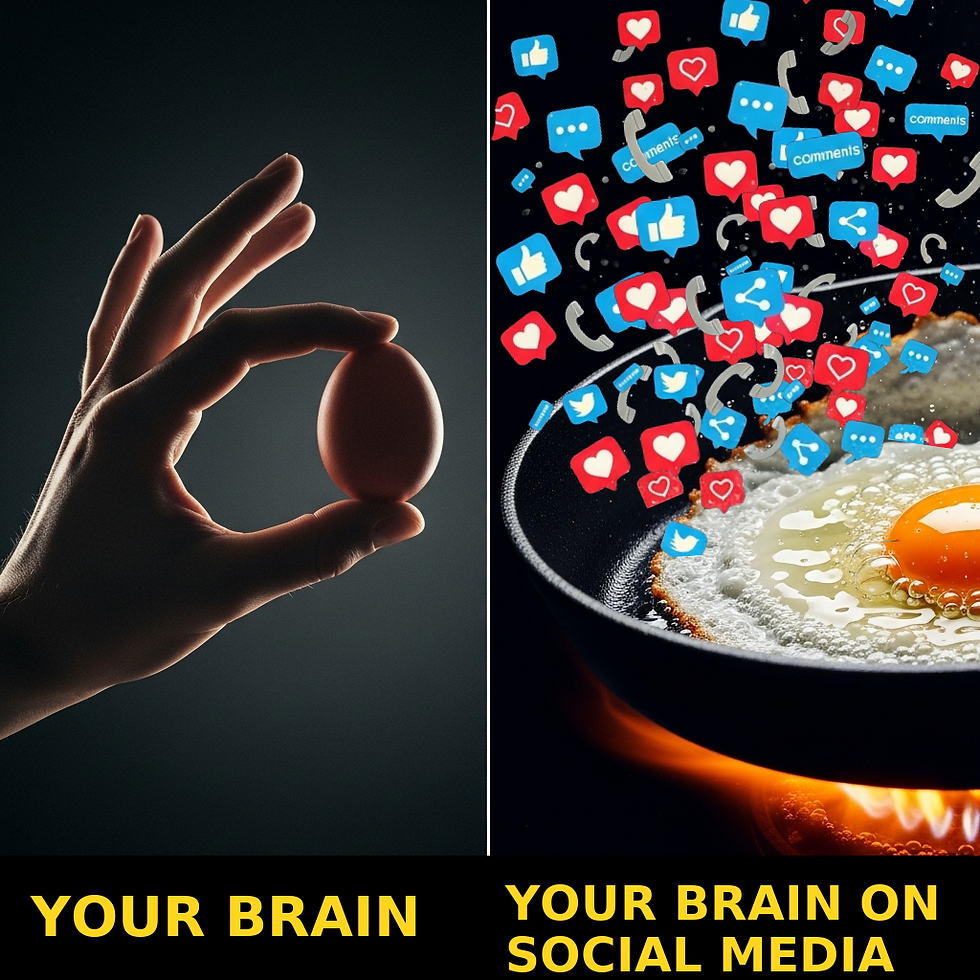
Same dopamine pathway. Same developing brain. Different decade.
The mechanics are not accidents. Infinite scroll uses the same variable reward schedule that makes slot machines compulsive. Each like triggers a dopamine spike neurologically identical to cocaine. Snapchat streaks and autoplay exploit habit-formation loops that mirror nicotine dependency. When access is removed, the withdrawal is real — documented clinically.

When the Algorithm Finds a Wound
Social media does not harm all young people equally. It is most destructive where it finds the most unmet need — and it is very good at finding it.

The Fire Beneath the Accelerant
Every young person who walks through The Radix Project's doors carries something before they ever pick up a phone. Housing instability. Schools that weren't resourced. Family structures fractured by systemic failures predating their birth. Neighborhoods where the visible pathways to status — to being seen, to mattering — run through the same networks that eventually connect to the justice system.
Social media does not create these conditions. It amplifies every single one. When belonging is unmet and the algorithm knows it, it feeds content that offers a substitute — communities built on shared grievance, shared identity, shared defiance. For boys, that pipeline runs toward isolation, nihilism, radicalization. For girls, toward impossible comparisons and communities that normalize self-harm. For both, the platform is where identity that leads to justice involvement is built, reinforced, and monetized.

Loneliness is not a side effect of social media use. It is a product feature. The more isolated a user becomes from real-world connection, the more dependent they become on the platform — and the more profitable they are to the companies that built it.
What It's Doing to Who They Become
Values are not innate. They form in the environment a child spends the most time in. For this generation, that environment is a feed designed to reward whatever produces the most engagement.

Moral development requires empathy. Empathy requires human connection. Social media replaces human connection with curated content — and the moral development of a generation is measurably suffering for it. What isn't repaired in this environment does not disappear. It compounds. It crystallizes into identity. And it shows up, eventually, in the decisions that bring young people into contact with the justice system.
This Is the Same Moment. Different Drug.

We Repeat What We Don't Repair
In 1983, the country eventually looked up. The damage by then was generational. We are at that moment again — and what isn't repaired today will be repeated tomorrow.
Comments